工具调用(Function Calling)
Function Calling(函数调用)是让 LLM 能够使用外部工具的核心机制。
Function Calling(函数调用)允许模型决定何时调用工具、调用哪个工具,以及传递什么参数。
为什么需要 Function Calling?
想象一下,LLM 是一个聪明但手无寸铁的顾问。它知道很多知识,但不能:
- 获取实时信息(如最新天气、股票价格)
- 执行计算(如复杂的数学运算)
- 操作外部系统(如发送邮件、读写文件)
Function Calling 为 LLM 提供了双手,让它能够突破自身限制,执行实际任务。
Function Calling 的工作原理
Function Calling 的基本流程如下:
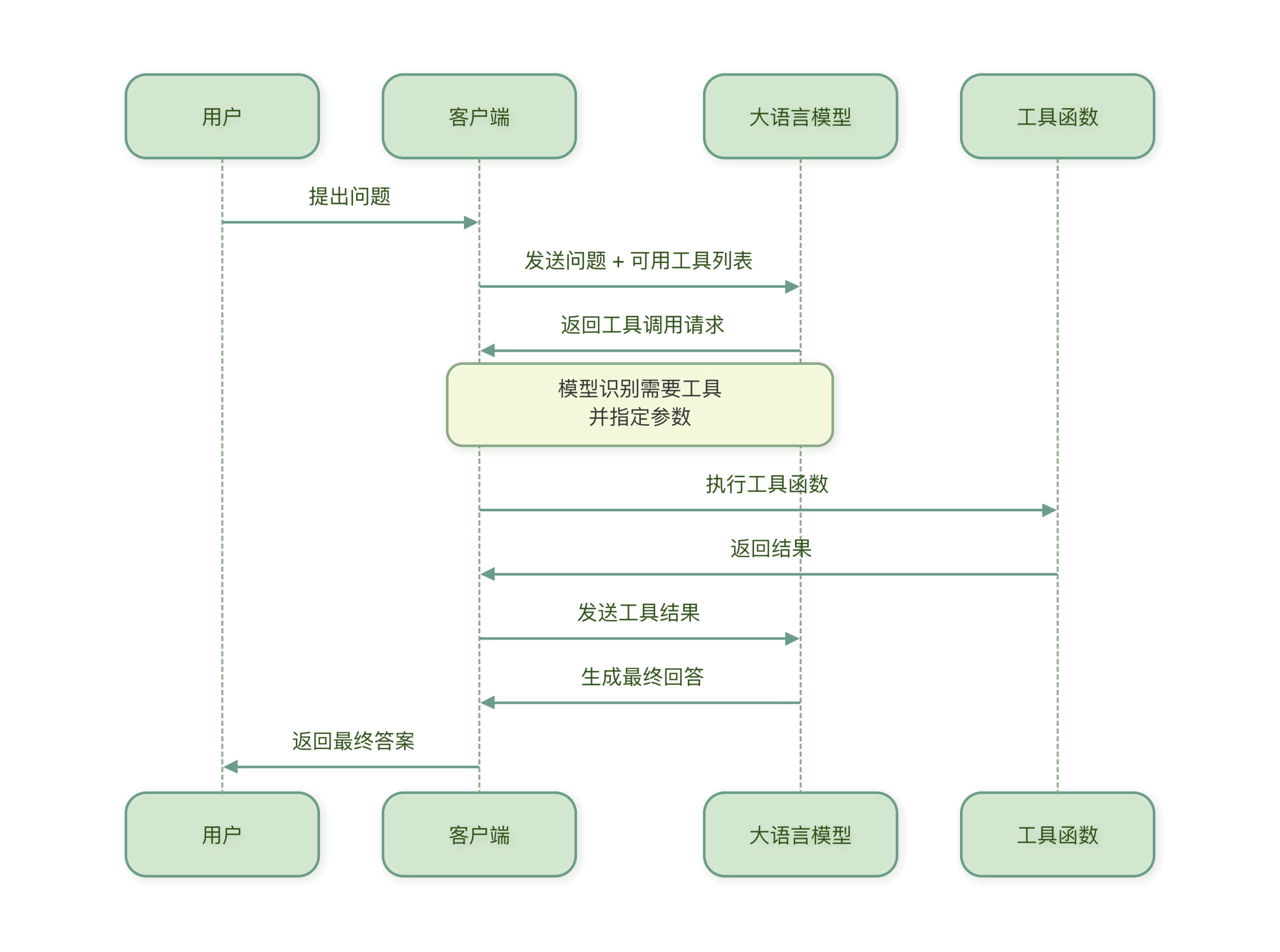
核心概念
- 工具定义:描述一个工具的功能、参数和返回值
- 工具选择:LLM 根据用户问题选择合适的工具
- 参数提取:LLM 从问题中提取工具所需的参数
- 结果处理:将工具执行结果整合到最终回答中
实例说明
假设我们有一个查询天气的工具,当用户问北京今天天气如何?时:
- LLM 识别出需要调用天气查询工具
- 从问题中提取参数:
city="北京",date="今天" - 调用天气 API 获取数据
- 将天气数据整合成友好的回答返回给用户
工具定义与描述编写
要让 LLM 正确使用工具,首先需要清晰地定义工具,好的工具定义应该像一份清晰的说明书,让 LLM 明白:
- 这个工具是做什么的?
- 什么时候使用它?
- 需要什么参数?
- 参数是什么格式?
工具定义的结构
一个完整的工具定义通常包含以下部分:
实例
# 工具定义示例结构
weather_tool = {
"name": "get_weather", # 工具名称
"description": "获取指定城市的天气信息", # 工具描述
"parameters": { # 参数定义
"type": "object",
"properties": {
"city": {
"type": "string",
"description": "城市名称,如'北京'、'上海'"
},
"date": {
"type": "string",
"description": "日期,格式'YYYY-MM-DD',或'今天'、'明天'",
"enum": ["今天", "明天", "后天"]
}
},
"required": ["city"] # 必填参数
}
}
weather_tool = {
"name": "get_weather", # 工具名称
"description": "获取指定城市的天气信息", # 工具描述
"parameters": { # 参数定义
"type": "object",
"properties": {
"city": {
"type": "string",
"description": "城市名称,如'北京'、'上海'"
},
"date": {
"type": "string",
"description": "日期,格式'YYYY-MM-DD',或'今天'、'明天'",
"enum": ["今天", "明天", "后天"]
}
},
"required": ["city"] # 必填参数
}
}
编写优质的工具描述
1. 描述要清晰具体
- 不好的描述:查询天气
- 好的描述:获取指定城市在特定日期的天气信息,包括温度、湿度、风速和天气状况(晴、雨、多云等)
2. 参数描述要详细
不好的参数描述:
"city": {"type": "string"}
好的参数描述:
"city": {
    "type": "string",
    "description": "完整的城市名称,如'北京市'、'上海市'。不要使用简称或拼音。"
}
3. 使用枚举限制选项
对于有限的选项,使用枚举(enum)帮助 LLM 理解:
"unit": {
    "type": "string",
    "description": "温度单位",
    "enum": ["celsius", "fahrenheit"],
    "default": "celsius"
}
4. 提供示例值
在描述中提供示例,帮助 LLM 理解格式:
"date": {
    "type": "string",
    "description": "日期,格式应为'YYYY-MM-DD',例如'2024-06-15'"
}
实用工具定义示例
1. 计算器工具
calculator_tool = {
    "name": "calculate",
    "description": "执行数学计算,支持加减乘除、幂运算等基本运算",
    "parameters": {
        "type": "object",
        "properties": {
            "expression": {
                "type": "string",
                "description": "数学表达式,如'2 + 3 * 4'、'sqrt(16)'、'sin(30)'"
            }
        },
        "required": ["expression"]
    }
}
2. 搜索工具
search_tool = {
    "name": "search_web",
    "description": "在互联网上搜索最新信息",
    "parameters": {
        "type": "object",
        "properties": {
            "query": {
                "type": "string",
                "description": "搜索关键词,尽量具体明确"
            },
            "num_results": {
                "type": "integer",
                "description": "返回结果数量,默认为5",
                "default": 5,
                "minimum": 1,
                "maximum": 10
            }
        },
        "required": ["query"]
    }
}
3. 文件操作工具
file_tool = {
    "name": "read_file",
    "description": "读取指定文件的内容",
    "parameters": {
        "type": "object",
        "properties": {
            "file_path": {
                "type": "string",
                "description": "文件的完整路径,如'/home/user/document.txt'"
            },
            "encoding": {
                "type": "string",
                "description": "文件编码,默认为'utf-8'",
                "default": "utf-8"
            }
        },
        "required": ["file_path"]
    }
}
工具定义的最佳实践
- 名称简洁明确:使用动词开头,如
get_、calculate_、search_ - 描述完整详细:说明工具的用途、适用场景和限制
- 参数验证充分:定义参数类型、范围、格式要求
- 提供默认值:为可选参数提供合理的默认值
- 考虑错误情况:在描述中说明可能出现的错误和限制
工具定义的验证
定义工具后,应该进行验证测试:
def validate_tool_definition(tool_def):
    """验证工具定义是否完整"""
    required_fields = ["name", "description", "parameters"]

    for field in required_fields:
        if field not in tool_def:
            return False, f"缺少必要字段: {field}"

    # 检查参数结构
    if "properties" not in tool_def["parameters"]:
        return False, "参数定义缺少properties字段"

    return True, "工具定义完整"

# 测试验证
is_valid, message = validate_tool_definition(weather_tool)
print(f"验证结果: {is_valid}, 消息: {message}")
参数提取与验证
LLM 从用户问题中提取参数后,需要对这些参数进行验证和处理,确保工具能够正确执行。
参数提取过程
当 LLM 决定调用工具时,它会分析用户输入,提取出工具所需的参数:
用户输入: "查询北京明天的天气温度"
工具: get_weather
提取参数: {"city": "北京", "date": "明天"}
参数提取的挑战
参数提取可能遇到以下问题:
- 信息缺失:用户没有提供所有必要信息
- 格式不符:用户提供的格式与工具要求不符
- 歧义解析:同一信息可能有多种解释
- 上下文依赖:参数需要结合对话历史理解
参数验证方法
1. 类型验证
确保参数类型符合要求:
def validate_parameters(params, tool_def):
    """验证参数类型"""
    errors = []

    for param_name, param_def in tool_def["parameters"]["properties"].items():
        if param_name in params:
            param_value = params[param_name]
            expected_type = param_def.get("type")

            # 类型检查
            if expected_type == "string" and not isinstance(param_value, str):
                errors.append(f"参数'{param_name}'应为字符串类型")
            elif expected_type == "integer" and not isinstance(param_value, int):
                errors.append(f"参数'{param_name}'应为整数类型")
            elif expected_type == "number" and not isinstance(param_value, (int, float)):
                errors.append(f"参数'{param_name}'应为数字类型")
            elif expected_type == "boolean" and not isinstance(param_value, bool):
                errors.append(f"参数'{param_name}'应为布尔类型")

    return errors
```
2. 范围验证
检查参数值是否在允许范围内:
def validate_range(params, tool_def):
    """验证参数范围"""
    errors = []

    for param_name, param_def in tool_def["parameters"]["properties"].items():
        if param_name in params:
            param_value = params[param_name]

            # 检查最小值
            if "minimum" in param_def and param_value < param_def["minimum"]:
                errors.append(f"参数'{param_name}'不能小于{param_def['minimum']}")

            # 检查最大值
            if "maximum" in param_def and param_value > param_def["maximum"]:
                errors.append(f"参数'{param_name}'不能大于{param_def['maximum']}")

            # 检查枚举值
            if "enum" in param_def and param_value not in param_def["enum"]:
                errors.append(f"参数'{param_name}'必须是{param_def['enum']}中的一个")

    return errors
3. 必填参数验证
确保所有必填参数都已提供:
def validate_required(params, tool_def):
    """验证必填参数"""
    errors = []
    required_params = tool_def["parameters"].get("required", [])

    for param_name in required_params:
        if param_name not in params:
            errors.append(f"缺少必填参数: {param_name}")

    return errors
完整的参数验证系统
实例
class ParameterValidator:
"""参数验证器"""
def __init__(self, tool_def):
self.tool_def = tool_def
def validate(self, params):
"""执行完整的参数验证"""
all_errors = []
# 检查必填参数
required_errors = self.validate_required(params)
all_errors.extend(required_errors)
# 检查参数类型
type_errors = self.validate_type(params)
all_errors.extend(type_errors)
# 检查参数范围
range_errors = self.validate_range(params)
all_errors.extend(range_errors)
# 检查额外参数(未定义的参数)
extra_errors = self.validate_extra(params)
all_errors.extend(extra_errors)
return len(all_errors) == 0, all_errors
def validate_required(self, params):
"""验证必填参数"""
errors = []
required_params = self.tool_def["parameters"].get("required", [])
for param_name in required_params:
if param_name not in params or params[param_name] is None:
errors.append(f"缺少必填参数: {param_name}")
return errors
def validate_type(self, params):
"""验证参数类型"""
errors = []
for param_name, param_value in params.items():
if param_name in self.tool_def["parameters"]["properties"]:
param_def = self.tool_def["parameters"]["properties"][param_name]
expected_type = param_def.get("type")
if expected_type == "string" and not isinstance(param_value, str):
errors.append(f"参数'{param_name}'应为字符串类型,实际为{type(param_value).__name__}")
elif expected_type == "integer" and not isinstance(param_value, int):
errors.append(f"参数'{param_name}'应为整数类型,实际为{type(param_value).__name__}")
elif expected_type == "number" and not isinstance(param_value, (int, float)):
errors.append(f"参数'{param_name}'应为数字类型,实际为{type(param_value).__name__}")
elif expected_type == "boolean" and not isinstance(param_value, bool):
errors.append(f"参数'{param_name}'应为布尔类型,实际为{type(param_value).__name__}")
return errors
def validate_range(self, params):
"""验证参数范围"""
errors = []
for param_name, param_value in params.items():
if param_name in self.tool_def["parameters"]["properties"]:
param_def = self.tool_def["parameters"]["properties"][param_name]
# 检查最小值
if "minimum" in param_def and param_value < param_def["minimum"]:
errors.append(f
"""参数验证器"""
def __init__(self, tool_def):
self.tool_def = tool_def
def validate(self, params):
"""执行完整的参数验证"""
all_errors = []
# 检查必填参数
required_errors = self.validate_required(params)
all_errors.extend(required_errors)
# 检查参数类型
type_errors = self.validate_type(params)
all_errors.extend(type_errors)
# 检查参数范围
range_errors = self.validate_range(params)
all_errors.extend(range_errors)
# 检查额外参数(未定义的参数)
extra_errors = self.validate_extra(params)
all_errors.extend(extra_errors)
return len(all_errors) == 0, all_errors
def validate_required(self, params):
"""验证必填参数"""
errors = []
required_params = self.tool_def["parameters"].get("required", [])
for param_name in required_params:
if param_name not in params or params[param_name] is None:
errors.append(f"缺少必填参数: {param_name}")
return errors
def validate_type(self, params):
"""验证参数类型"""
errors = []
for param_name, param_value in params.items():
if param_name in self.tool_def["parameters"]["properties"]:
param_def = self.tool_def["parameters"]["properties"][param_name]
expected_type = param_def.get("type")
if expected_type == "string" and not isinstance(param_value, str):
errors.append(f"参数'{param_name}'应为字符串类型,实际为{type(param_value).__name__}")
elif expected_type == "integer" and not isinstance(param_value, int):
errors.append(f"参数'{param_name}'应为整数类型,实际为{type(param_value).__name__}")
elif expected_type == "number" and not isinstance(param_value, (int, float)):
errors.append(f"参数'{param_name}'应为数字类型,实际为{type(param_value).__name__}")
elif expected_type == "boolean" and not isinstance(param_value, bool):
errors.append(f"参数'{param_name}'应为布尔类型,实际为{type(param_value).__name__}")
return errors
def validate_range(self, params):
"""验证参数范围"""
errors = []
for param_name, param_value in params.items():
if param_name in self.tool_def["parameters"]["properties"]:
param_def = self.tool_def["parameters"]["properties"][param_name]
# 检查最小值
if "minimum" in param_def and param_value < param_def["minimum"]:
errors.append(f